
Following the results of 2025, the city budget demonstrated sustainable growth: revenues increased compared to the previous year both due to own revenues and thanks to gratuitous transfers from higher-level budgets, reported the Deputy Head of the Executive Committee, Head of the Finance Department Svetlana Mulyukova. Planned assignments for tax and non-tax revenues were fulfilled with a significant over-execution.
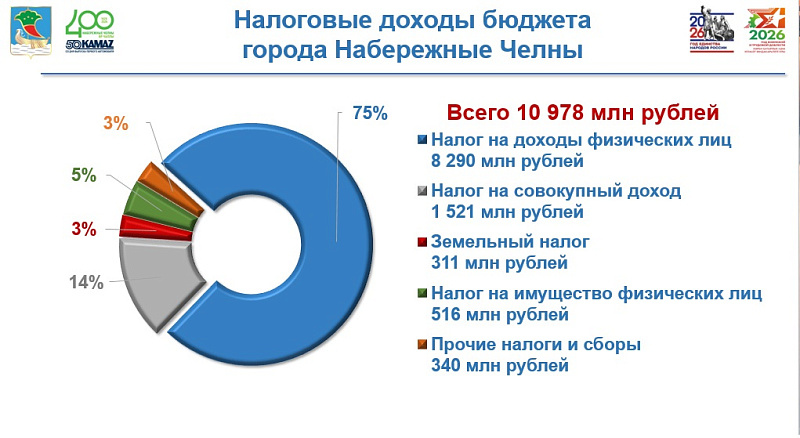
The main growth of own revenues was ensured by the receipt of personal income tax, the patent taxation system, and non-tax payments. The share of personal income tax in the structure of own revenues remains dominant. Receipts from property taxes remained at a stable level, while a slight decrease was noted in land tax, associated with the reassessment of the cadastral value of plots.
Non-tax revenues grew mainly due to land lease payments. Timely receipt of funds allowed for the full financing of budget-funded sectors and the fulfillment of all assumed obligations.
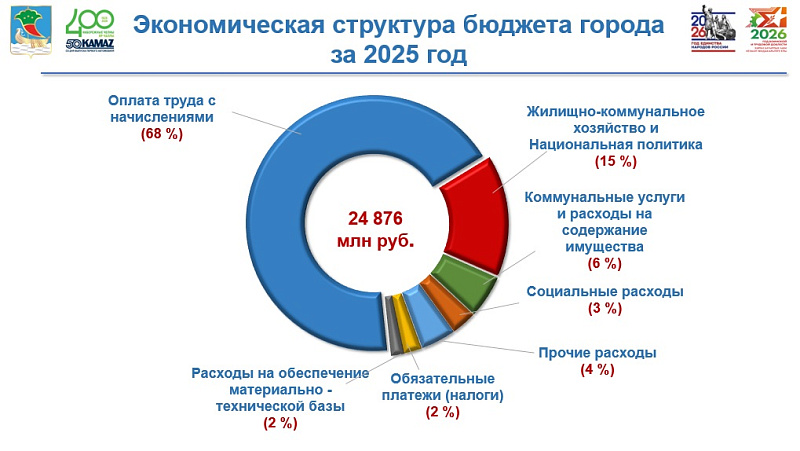
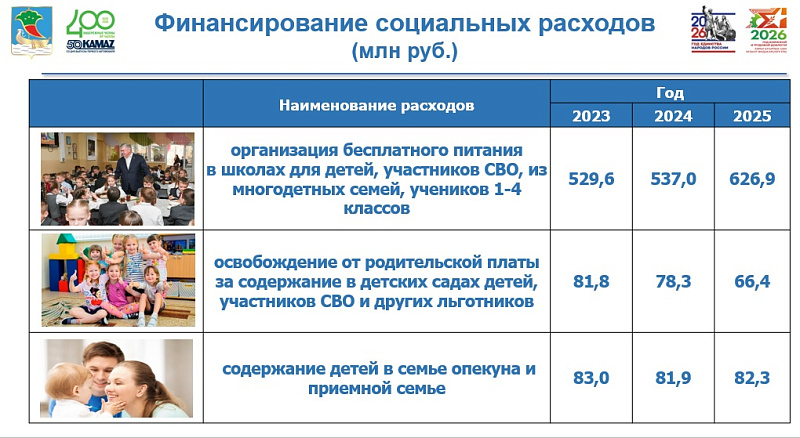
"Timely receipt of revenues allowed us to ensure funding for the city's budget-funded sectors and thereby fulfill all assumed budget obligations. We maintain the social orientation of the budget: more than 67% of all expenditures are directed to education, culture, sports, and support for citizens," noted Svetlana Mulyukova.
The payroll fund traditionally dominates the structure of expenditures. A significant part of the budget is directed to housing and communal services, maintenance of municipal property, and social payments. More than two-thirds of all expenditures are allocated to the socio-cultural sphere – the growth is due to the opening of a new school, the increase in the minimum wage, and the indexation of salaries for industry specialists.
In 2026, it is planned to direct the remaining funds to key areas: security of educational organizations, reimbursement of losses to carriers, improvement and repair of exterior improvement facilities, provision of the payroll fund for municipal workers, anti-terrorist security of sports facilities, maintenance of the "Safe City" system, development of design documentation for the tram line, and execution of court decisions. Inter-budgetary transfers to support education, sports, culture, and territorial public self-governments are also taken into account.
Mayor Nail Magdeev expressed words of gratitude to labor collectives, heads of enterprises, organizations, and institutions, primarily to КАМАЗ, as well as to representatives of small and medium-sized businesses. He emphasized that SMEs form 35% of local budget revenues, and 114 thousand people are employed in this sphere, which represents a huge economic force. At the same time, КАМАЗ, as a city-forming enterprise, remains the foundation of the budget.
The Mayor drew attention to the scale of social obligations – more than 200 educational institutions, schools, kindergartens, and institutions of additional education operate in the city.
"Therefore, we are obliged to form the revenue side of the budget timely and accurately – ruble for ruble. This applies to tax and non-tax revenues. We have serious reserves for replenishing the treasury, in particular, work with arrears, which exceeds 200 million rubles. Unfortunately, the share of late payment of income and property taxes by a number of enterprises is growing, and this situation must be changed."
Deputies of the City Council approved the report on budget execution and approved the amendments to its parameters unanimously.